



MARKET REVIEW FOREX US-CHINA
Trade Truce Extended, but a Hawkish Fed Keeps the Dollar Bid
Washington and Beijing gave themselves two more months before Xi and Trump even sat down. With US yields above 5% and business activity running hot, though, the Fed is still what's moving the dollar.
Followme News Desk | September 24, 2026
Market Review
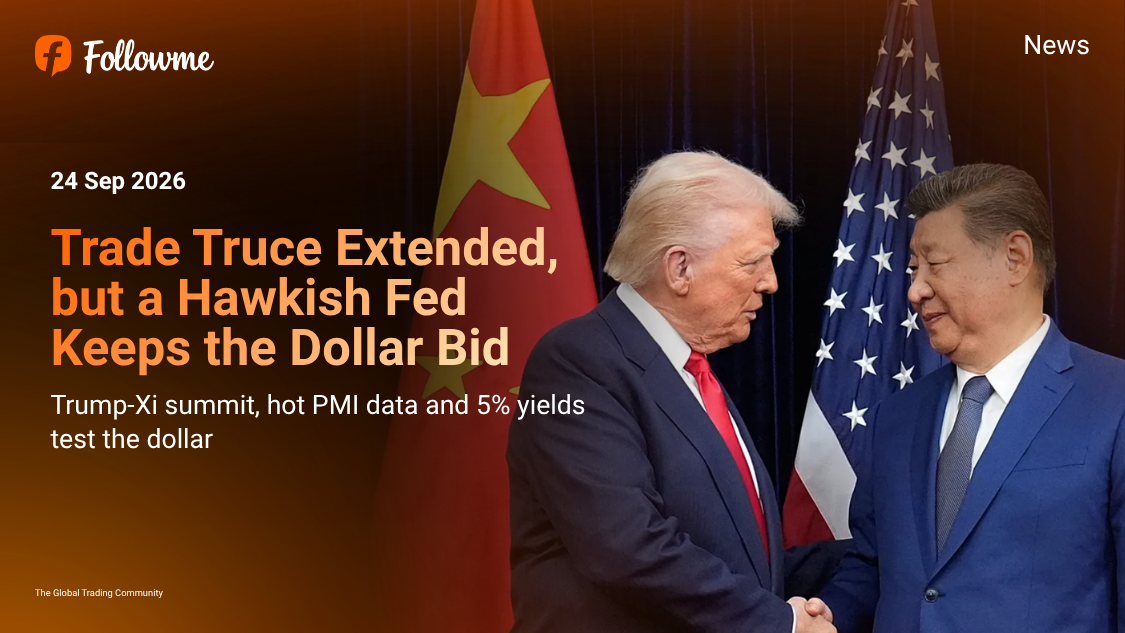
Xi hadn't even left the airport before Bessent confirmed the truce was getting extended. Just not by much. The "Busan Agreement" was due to run out on November 10 and will now last until January 10. Bessent agreed to it with Vice Premier He Lifeng in a meeting on Wednesday that wasn't on anyone's schedule. He said the two sides could have a bigger economic package ready by January, or they might just roll the current deal over again. Xi told reporters he was confident the trip would go well.
Two months is less than people wanted. USTR Jamieson Greer talked about three to six. Goldman went in expecting an extension, and MUFG was looking for some progress but nothing major in tech. So the deadline is sorted, and today's White House meeting is left with the difficult stuff: rare earth exports, chip and AI rules, and tariffs.
If anyone was hoping the US data would take some pressure off the Fed, it didn't. S&P Global's flash composite PMI came in at 58.4 for September. The forecast was 55.2 and August was 56. Services hit 58.7 against 56.0 expected, and manufacturing hit 57.0 against 53.6. Business activity hasn't grown this fast in over five years. What the Fed will focus on is costs. Input prices rose at their quickest rate in four years, mostly from fuel and transport, and supply chain delays are the worst the survey has recorded outside of COVID. S&P's Chris Williamson said companies are getting more pricing power, which usually means inflation isn't done.
The Fed only hiked a week ago, taking rates to 3.75%-4.00% on September 16, and it's pencilled in one more move before the end of the year. The BoJ and ECB have hiked too, but the market sees the Fed as the one most likely to keep going. US 5- and 10-year yields are now above 5%, and the dollar is near a two-month high. Gold took the hit. It dropped through $4,300 after the PMI data and traded around $4,282, down 1.74% on the day and more than 22% below January's $5,595 peak.
And there's Iran. Kpler data shows China buying more than 80% of Iran's seaborne oil exports, so Beijing has something Washington wants. Wang Yi met Iran's foreign minister on September 16 and said Hormuz should reopen, but he didn't put any real pressure on Tehran or offer to mediate. Most analysts expect a quiet chat about sanctions and not much else. WTI is just under $92, Brent is above $101, and the strait is still closed.
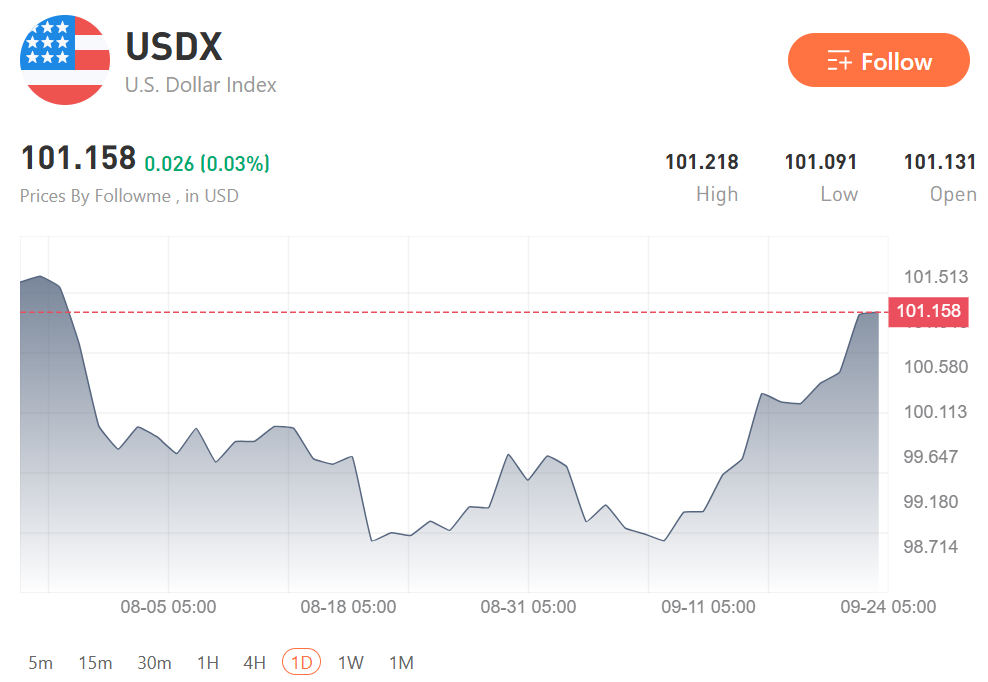
USDX price as of 24 September 2026 - View Live Chart →
The Facts
- Trade truce: Now runs to January 10 instead of November 10, according to Bessent. Greer had floated three to six months. A bigger deal by January is possible, and so is another rollover.
- Summit agenda: Rare earths, chips and AI, tariffs, Iran and Taiwan. Nobody went in expecting a big breakthrough.
- US flash PMI (September): Composite 58.4 (forecast 55.2), services 58.7 (forecast 56.0), manufacturing 57.0 (forecast 53.6). Input costs rose at their fastest pace in four years.
- Fed: Hiked 25bp to 3.75%-4.00% on September 16 and expects one more hike this year. The next meeting is October 27-28.
- Yields and dollar: US 5- and 10-year yields are above 5%, and the dollar is near a two-month high. EUR/USD has dropped below 1.1400, and GBP/USD is close to its July lows.
- PBOC fix: USD/CNY set at 6.7489. That's weaker than the day before (6.7468) and well above the Reuters estimate of 6.7184.
- AUD/USD: Heading toward 0.7000. August unemployment rose to 4.6% against 4.5% expected, although the economy added 39.5K jobs, more than forecast.
- Gold: Below $4,300. China imported more than 1,000 tonnes between January and August, compared with 886 tonnes in all of last year. The PBoC has now added to its gold reserves for 22 months in a row. BMI puts potential support at around $3,800.
- Oil and Iran: WTI near $92 and Brent above $101. China takes more than 80% of Iran's seaborne crude, and Shanghai crude futures hit a record 929.4 yuan this month.
What It Means
Getting rid of the November deadline helps, but January 10 isn't far off. Two months is tight for the kind of package Bessent is talking about, so January will probably start showing up as the next risk date. If today doesn't produce anything real on rare earths or chips, the extension just looks like kicking the can.
Honestly, I don't think the dollar cares that much about today. The PMI shows an economy running hot with costs climbing, and that keeps another Fed hike on the table regardless of what happens at the White House. If the summit goes badly, the dollar probably picks up some safe-haven buying. If it goes well, it might give back a little. Either way, 5% yields are doing most of the work.
The yuan is where you'll see the summit reaction most clearly. Earlier this month the PBOC set a stronger fix several days running to hold the yuan up against the dollar before Xi's trip. This morning's fix was weaker than yesterday's and well above the Reuters estimate. One day doesn't mean Beijing has changed course, but it's a good reason to keep an eye on USD/CNH. Gold is dealing with higher real yields, which is bad news for a metal that doesn't pay anything. What's stopping it from falling harder is China, which keeps buying at a record pace.
What Traders Should Watch
USD/CNH: The price direction after the summit tells you what the market thought. If it falls, traders liked the details. If it rises, they didn't, or they're worried about fresh trade tension.
AUD/USD: The price level at 0.7000 is the line in the sand. The Aussie trades as a China proxy, so it'll react to the summit more than most. It's already sliding after the rise in unemployment, and a weak result from Washington could be what pushes it through.
Nasdaq: The price level at record highs doesn't leave much room for bad news. Tighter rules on chips or AI would hit tech quickly, and if that spreads into a wider sell-off, the dollar gets another lift.
USDX: The price level near a two-month high is the Fed's story more than the summit's. If the dollar stays up there even after a friendly outcome, that tells you where the market's focus really is. The next big date is October 27-28 FOMC.
Gold: The price range from $4,300 to $4,400 is the zone to watch. Gold is already under $4,300, so a move back above $4,350 and then $4,400 would suggest the selling went too far. If it can't get back there, BMI's $3,800 area starts to come into view, but that's a rough support zone and not a hard floor.
WTI: The price level is just under $92 on WTI depends on Hormuz. Nobody expects China to push Iran, so even a small commitment to the summit readout would surprise the market. Energy is already pushing up US business costs, so a drop in oil would matter to the Fed too.
The Bottom Line The truce buys some time, but not a lot, and January 10 is now the date to keep in mind. Today decides whether this turns into a real deal or just another extension. The Fed still matters more for the dollar than anything said at the White House. If USD/CNH is lowered by the New York close, the market likes what it heard. If it isn't, January will come around quickly.
Follow us for daily market insights, analysis, and the tools you need to trade with confidence.
Want to stay ahead of major macro developments that move the market? 👉 Follow Followme and check out the Weekly Economic Calendar
September 24, 2026 | This report is for informational purposes only and does not constitute financial advice. © 2026 Followme News
Download Followme Application


Follow us on:


Penafian: Pandangan yang dinyatakan adalah semata-mata dari pengarang dan tidak mewakili kedudukan rasmi Followme. Followme tidak bertanggungjawab ke atas ketepatan, kesempurnaan, atau kebolehpercayaan maklumat yang diberikan dan tidak bertanggungjawab untuk sebarang tindakan yang diambil berdasarkan kandungan, melainkan dinyatakan secara bertulis secara jelas.
 Tiada ulasan lagi. Jadilah yang pertama berkongsi pandangan anda.